Beef
Ground Beef Jerky Recipe: Easy Homemade Snack
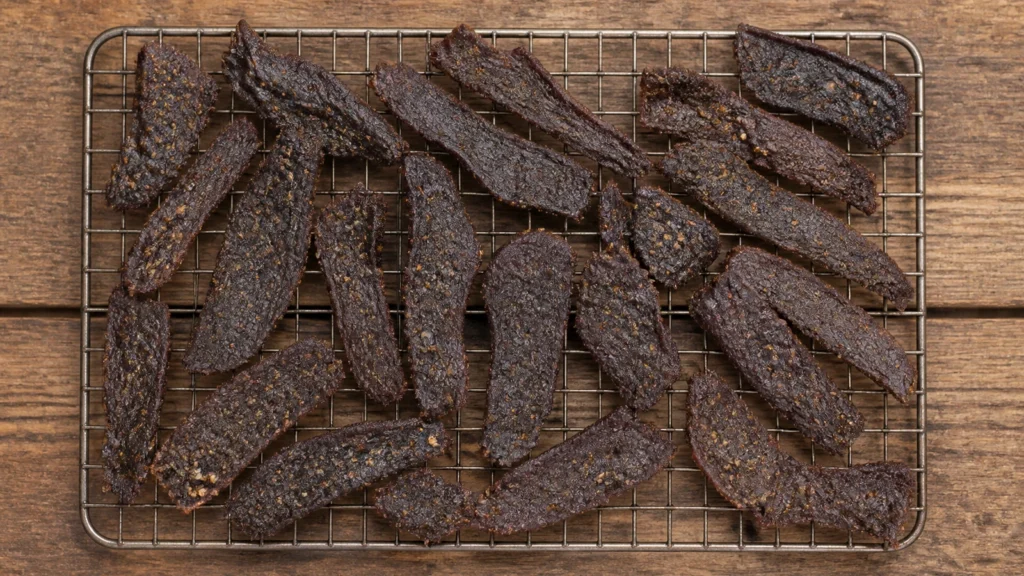
A ground beef jerky recipe gives you the same dried, seasoned snack as the whole muscle version without needing a slicer, a marinade day, or an expensive cut of eye of round.
It also has a texture people often prefer. Ground meat dries into a firm, snappy strip you can bite cleanly, rather than the long chew you get from sliced muscle fibre.
Below you will find the ingredient table, step-by-step directions, drying times by appliance, tips, variations, serving ideas, troubleshooting, storage guidance, and six common questions.
Table of Contents
The short version of this ground beef jerky recipe is below.
Getting a ground beef jerky recipe right is mostly about timing.
Key Takeaways for This Ground Beef Jerky Recipe
- Use the leanest halal ground beef you can find; 93/7 or leaner is essential.
- Fat cannot be dried. It goes rancid and it is the main cause of spoiled jerky.
- Heat the strips to 160°F (71°C) before or after drying, never neither.
- Roll to an even ¼ inch; uneven strips dry at different rates.
- Curing salt is optional for short storage, necessary for long storage.
- Done jerky cracks when bent and does not snap in half.
Here is what a ground beef jerky recipe looks like at a glance.
This ground beef jerky recipe scales up without changing the method.
Why Make Jerky from Ground Beef
Traditional jerky needs a lean whole muscle cut, partially frozen so you can slice it thin and evenly, then marinated for the better part of a day. It is good, but it is a project.
Ground beef removes the slicing entirely. The seasoning goes straight into the meat rather than soaking in from the outside, which means the flavour is even all the way through and the resting time drops to an hour.
The trade is that ground meat carries more risk. Grinding spreads any surface bacteria through the whole batch, so the temperature step below is not optional the way it nearly is with a whole muscle strip.
Everything in this ground beef jerky recipe is a standard supermarket item.
Read the notes below before starting the ground beef jerky recipe.
Ground Beef Jerky at a Glance
| Detail | Value |
|---|---|
| Prep time | 20 minutes plus 1 hour chilling |
| Drying time | 4 to 6 hours |
| Method | dehydrator or oven |
| Safety step | 160°F (71°C) internal |
| Beef required | 93/7 or leaner |
| Yield | about 12 ounces from 2 pounds |
The method for this ground beef jerky recipe is straightforward from start to finish.
A good ground beef jerky recipe depends on a few simple choices.
Ingredients for Ground Beef Jerky
Weigh the seasonings if you can. Jerky is a preserved food, and the salt is doing more than flavouring it.
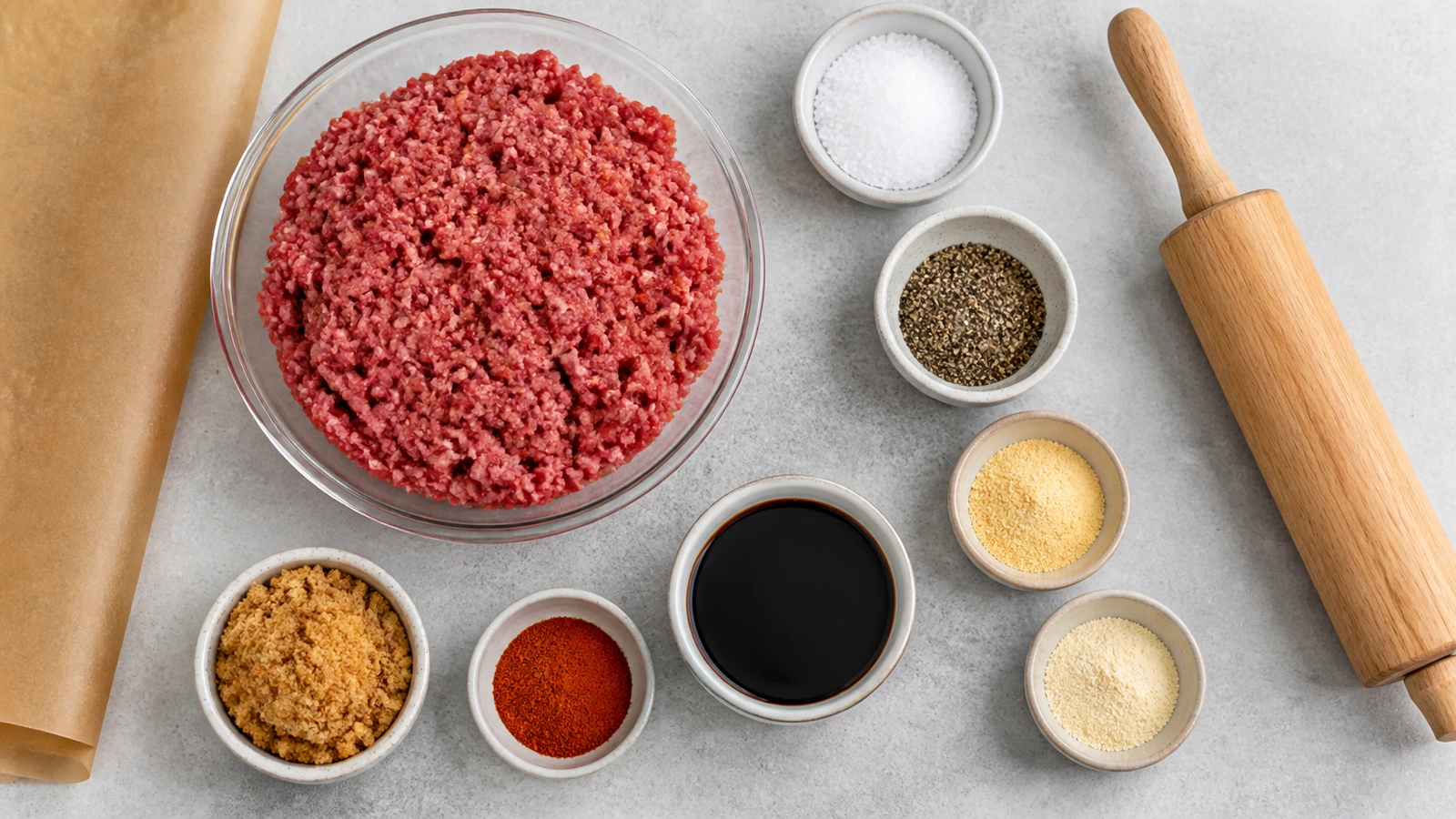
| Ingredient | Amount | Why it matters |
|---|---|---|
| Ground beef, 93/7 or leaner | 2 pounds | Fat cannot dry and turns rancid. |
| Kosher salt | 2 teaspoons | Draws out moisture and preserves. |
| Curing salt, Prague powder #1 | ½ teaspoon | Optional; required for storage beyond two weeks. |
| Soy sauce, halal | ¼ cup | Salt and savoury depth. |
| Worcestershire, halal | 2 tablespoons | Check the label; many brands contain anchovy and alcohol. |
| Brown sugar | 1 tablespoon | Balances the salt. |
| Black pepper, coarse | 2 teaspoons | The classic jerky note. |
| Garlic powder | 2 teaspoons | Distributes better than fresh garlic. |
| Onion powder | 1½ teaspoons | Rounds the seasoning. |
| Smoked paprika | 2 teaspoons | Smoke without a smoker. |
| Cayenne pepper | ½ teaspoon | Optional heat. |
| Liquid smoke | 1 teaspoon | Optional; a little goes a long way. |
A few habits separate a good ground beef jerky recipe from a disappointing one.
Nothing in this ground beef jerky recipe needs special equipment.
Why the Beef Must Be Very Lean
Drying removes water, not fat. Every gram of fat you start with is still there at the end, sitting on the surface of a shelf-stable snack with nothing to protect it.
That fat oxidises within days and gives jerky the stale, soapy taste people associate with a batch gone wrong. Use 93/7 at minimum, and 96/4 if your shop carries it.
Once the basic ground beef jerky recipe works, these are the directions worth taking it in.
Do You Need Curing Salt
For jerky eaten within a week or two and kept in the refrigerator, no. Kosher salt and thorough drying are enough.
For jerky stored at room temperature for a month or more, yes. Prague powder #1 guards against the bacteria that low-oxygen, low-moisture storage otherwise favours. Use exactly the stated amount and never more.
A ground beef jerky recipe is worth pairing with sides that balance it.
How to Make It Step by Step
- Mix every seasoning together in a bowl before it meets the meat.
- Add the seasoning to the cold beef and mix with your hands for 2 minutes.
- Cover and refrigerate 1 hour so the salt can work through the meat.
- Press the mixture between two sheets of parchment and roll to ¼ inch.
- Peel the top sheet away and cut into strips about 1 inch by 5 inches.
- Lay the strips on dehydrator trays or a wire rack over a baking sheet.
- Dry at 160°F (71°C) for the first hour to bring the meat to temperature.
- Drop to 145°F (63°C) and continue 3 to 5 hours, blotting fat as it beads.
- Test a cooled strip: it should crack when bent, not snap or bend limply.
- Cool completely on the rack before it goes anywhere near a container.
Most problems with a ground beef jerky recipe are easy to diagnose and fix.
The 160°F Safety Step
Ground beef must reach 160°F (71°C) throughout, higher than a whole steak, because grinding spreads surface bacteria through the entire batch. Drying alone does not reliably kill them.
Do it at the start by running the dehydrator at its highest setting for the first hour, or at the end by transferring the finished strips to a 275°F oven for ten minutes. One or the other is required.
Leftover ground beef jerky recipe keeps well when stored properly.
Safe Ground Beef Handling
Keep the beef cold through mixing and rolling, and wash everything the raw mixture touched. The USDA guidance on ground beef and food safety sets out the temperature and storage rules.
Home drying is the one preparation where cutting a corner on temperature has consequences you will not taste or see, so treat that step as fixed.
The questions below come up most often about this ground beef jerky recipe.
Drying Time Guide
| Appliance | Temperature | Time |
|---|---|---|
| Dehydrator | 160°F then 145°F | 4 to 6 hours |
| Oven with door ajar | 170°F (77°C) | 3 to 4 hours |
| Convection oven | 160°F (71°C) | 3 hours |
| Air fryer with rack | 160°F (71°C) | 2 to 3 hours |
| Jerky gun strips, thinner | 145°F (63°C) | subtract 1 hour |
| Strips rolled thicker | 145°F (63°C) | add 1 to 2 hours |
If this ground beef jerky recipe worked for you, these are the natural next ones to cook.
The Bend Test
Take a strip out and let it cool for five minutes, because warm jerky always feels softer than it is. Then bend it slowly.
It should crack along the fold without breaking in two. If it bends like leather it needs longer; if it snaps clean it has gone too far and will be brittle.
A ground beef jerky recipe rewards attention to a few small details.
Best Tips for Ground Beef Jerky
- Keep the meat cold at every stage; warm ground beef smears rather than rolls.
- Roll between parchment with a rolling pin for genuinely even thickness.
- Cut strips the same size so the whole tray finishes at the same time.
- Blot beading fat with kitchen paper every hour or so.
- Rotate dehydrator trays halfway; the bottom always runs warmer.
- Start checking an hour before you expect it to be ready.
- Cool completely before storing, or condensation will spoil the batch.
Easy Variations to Try
- Teriyaki. Double the brown sugar, add grated ginger, and drop the smoked paprika.
- Peppered. Triple the black pepper and press extra coarse grind onto the surface before drying.
- Sweet and spicy. Add a tablespoon of honey and a teaspoon of chilli flakes.
- Smoky barbecue. Two tablespoons of tomato paste and an extra teaspoon of liquid smoke.
- Cumin and coriander. A warmer, more savoury profile that suits lean beef well.
- Sugar free. Leave the brown sugar out and add a teaspoon more soy sauce.
What to Serve With It
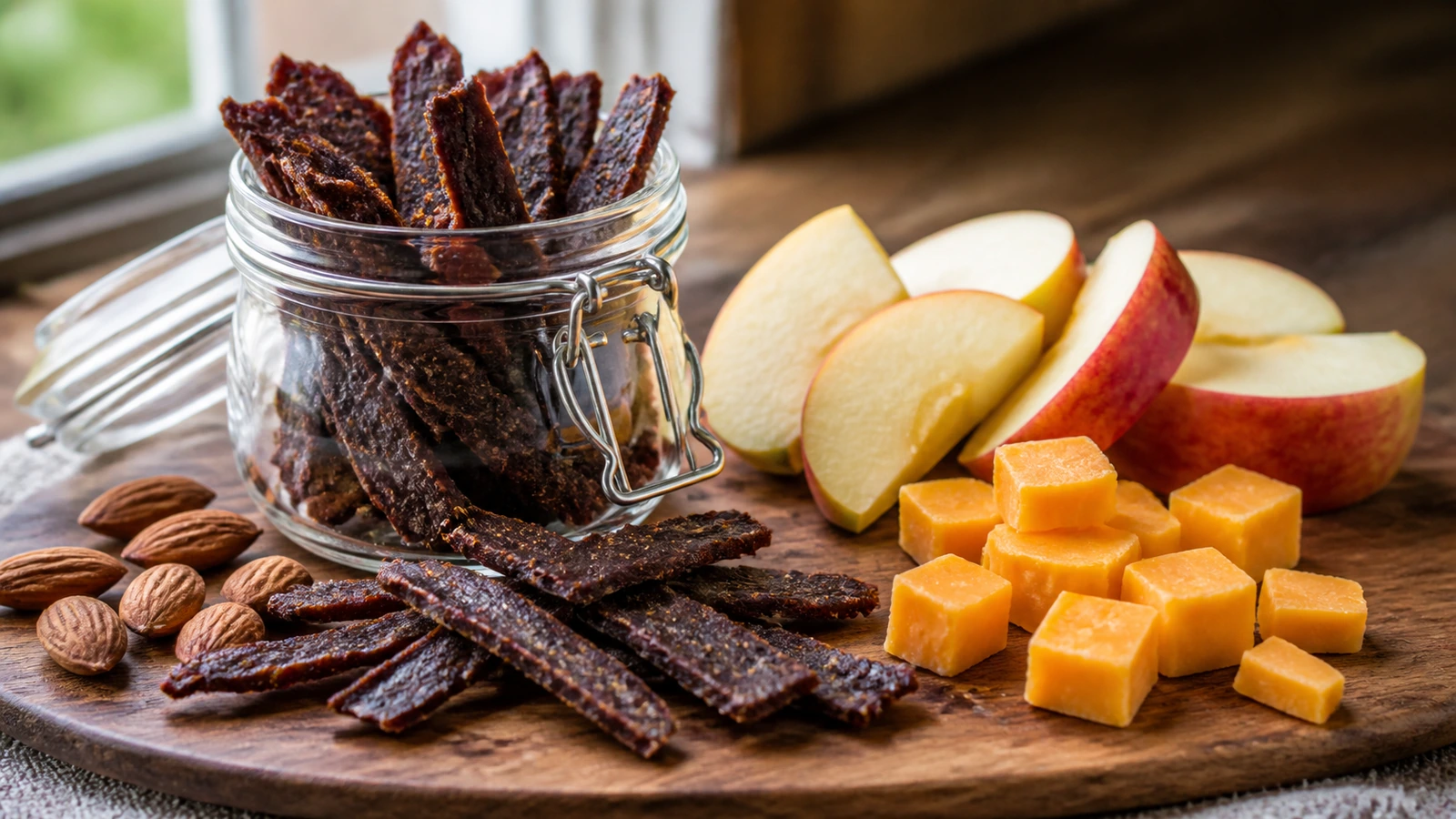
- A handful of almonds or cashews for a filling snack box.
- Sharp cheddar, which is the classic pairing for salty dried beef.
- Apple or pear slices to cut the salt.
- Chopped small and scattered over a salad instead of bacon.
- Crackers and pickles as a simple board.
- Plenty of water, since jerky is genuinely salty.
Fitting It into the Day
An ounce of jerky carries roughly 9 grams of protein and a substantial amount of sodium, which is what makes it useful on a hike and less useful three times a day.
Treat it as a protein snack rather than a meal, and pair it with fruit or nuts so it is not the only thing you are eating.
Troubleshooting Guide
| Problem | Likely cause | Fix |
|---|---|---|
| Greasy strips | Beef too fatty | Use 93/7 or leaner; blot during drying. |
| Jerky snaps in half | Over-dried | Start testing an hour earlier next batch. |
| Still soft after 6 hours | Rolled too thick or trays crowded | Roll to ¼ inch and leave air gaps. |
| Mould in storage | Stored warm or not fully dried | Cool completely; refrigerate without curing salt. |
| Bland | Not rested after seasoning | Give the mixture a full hour in the refrigerator. |
| Crumbles when cut | Mixture under-mixed | Mix a full 2 minutes so the proteins bind. |
If the Strips Come Out Greasy
Blot each strip with kitchen paper while it is still warm, then let it cool and blot again. That removes the surface fat that would otherwise turn rancid.
Jerky made from anything fattier than 90/10 will do this no matter how carefully you dry it, so the real fix is at the shop counter.
If the Texture Is Wrong
Crumbly jerky usually means the mixture was under-mixed. Two full minutes of working the seasoned beef develops enough protein binding to hold a strip together.
Brittle jerky is simply over-dried. It is still perfectly good chopped into salads or soups, and the next batch just needs checking an hour sooner.
How to Store It
Storage is where most homemade jerky fails, and it nearly always comes down to packing it before it was completely cool.
Refrigerator Storage
Without curing salt, keep it in an airtight container in the refrigerator and eat it within two weeks.
Leave it loosely covered on the counter for a day first if any strip still feels slightly tacky, then seal it.
Freezer and Long Storage
Vacuum sealed and frozen it keeps six months with no loss of texture, and thaws in about ten minutes at room temperature.
Made with curing salt and properly dried, it holds at room temperature for a month in an airtight jar kept out of sunlight.
Using Broken Pieces
The crumbs at the bottom of the jar are worth keeping. Blitzed to a powder they season soups, scrambled eggs, and popcorn.
Larger broken pieces soften nicely if you drop them into a stew for the last twenty minutes.
Frequently Asked Questions
Is ground beef jerky safe to make at home?
Yes, provided the meat reaches 160°F (71°C) at some point. Either run the dehydrator hot for the first hour or finish the strips in the oven.
Do I need a jerky gun?
No. Rolling the mixture between parchment and cutting it with a knife gives the same result, and arguably more even thickness.
Can I use 80/20 ground beef?
Not for jerky. The fat cannot be dried out and will go rancid within days, which spoils both the taste and the keeping time.
How long does homemade jerky last?
Two weeks refrigerated without curing salt, about a month at room temperature with it, and six months vacuum sealed in the freezer.
Can I make it in the oven?
Yes. Use a wire rack over a baking sheet at 170°F (77°C) with the door propped slightly open so moisture can escape.
Why is my jerky crumbly?
The mixture was not worked enough. Mixing for two full minutes develops the protein binding that holds a ground meat strip together.
More Ground Beef Recipes to Try
These take the same pound of ground beef in different directions. Every exact keyword links to its recipe page:
- keto recipes with ground beef
- taco meat recipe ground beef
- slow cooker ground beef recipes
- instant pot ground beef recipes
- mongolian ground beef recipe
- ground beef recipes healthy
- what to make with hamburger meat
All of them are more forgiving than this ground beef jerky recipe, which is the one preparation where the thermometer genuinely matters.
Final Thoughts
Lean beef, even thickness, and a genuine 160°F step are the three things that separate a good batch from a wasted one. Everything else is seasoning preference.
Once the routine is familiar, two pounds of ground beef and an afternoon give you a fortnight of snacks at roughly a third of what the packet costs.
There are no reviews yet. Be the first one to write one.
Reviews
Reader reviews are managed separately (outside this build).