Cake
Best red velvet cake frosting recipe: Silky & Foolproof
Get a silky, foolproof red velvet cake frosting recipe with cream cheese tips, perfect consistency, troubleshooting, and storage guidance.
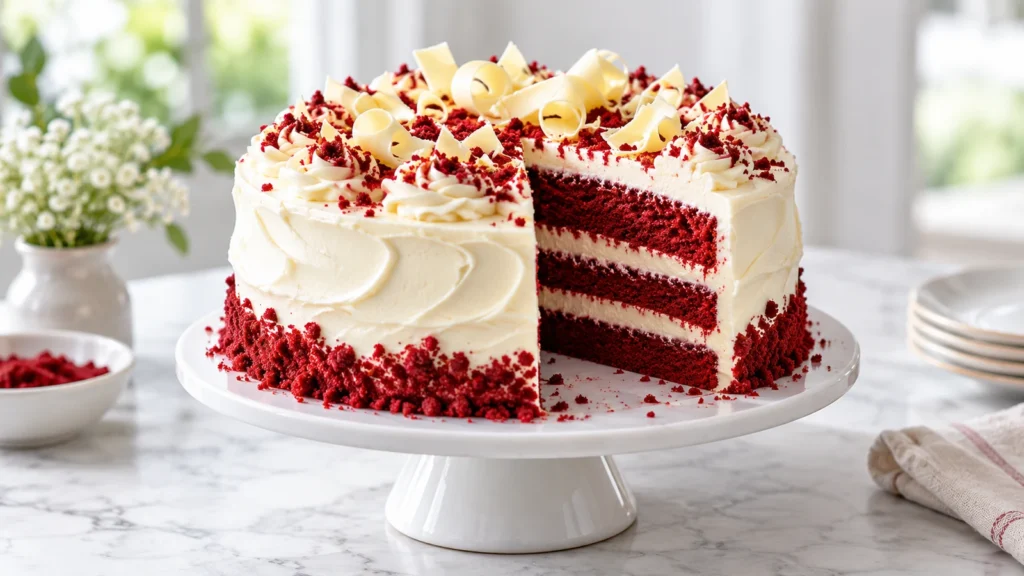
This red velvet cake frosting recipe creates a silky, tangy finish that balances the cake’s cocoa flavor without tasting overly sweet. It is sturdy enough for a layer cake, smooth enough for swoops, and dependable when the ingredients are prepared at the right temperatures.
Classic cream cheese frosting is the best all-around choice for red velvet cake, while ermine frosting offers a lighter, less tangy alternative. This red velvet cake frosting recipe includes precise consistency cues, troubleshooting advice, and scaling guidance for layer cakes, cupcakes, and Bundt cakes.
Table of Contents
Why You’ll Love This Red Velvet Cake Frosting Recipe
- Silky but stable: It spreads smoothly and holds simple piped decorations.
- Balanced sweetness: Cream cheese adds tang while a pinch of salt keeps the sugar in check.
- Foolproof guidance: Exact temperatures and visual cues help prevent runny or split frosting.
- Easy to scale: One batch covers a two-layer cake or 24 cupcakes.
- Versatile finish: The neutral white color complements a classic cake, a blue red velvet cake recipe, or decorative crumbs and sprinkles.
Choosing the Best Frosting for Red Velvet Cake
Cream cheese frosting is the familiar choice because its gentle acidity complements cocoa and buttermilk. It is rich, bright, and especially good between layers, though it must remain refrigerated because it contains perishable dairy.
Ermine frosting is made by cooking milk and flour into a thick base, cooling it, and whipping it with butter and sugar. It tastes less tangy and less sweet, with a soft, cloudlike texture. For background on this traditional technique, see this ermine frosting method and history.
Choose cream cheese frosting when you want recognizable tang, firm filling, and simple piping. Choose ermine when you prefer a lighter texture or want the cocoa flavor of the cake to stand forward. The main red velvet cake frosting recipe below is the more practical option for most home bakers because it requires no cooking.
Ingredients
- 16 ounces (454 g) full-fat brick-style cream cheese, cool at 60–65°F (16–18°C)
- 1 cup (226 g) unsalted butter, softened to 65–68°F (18–20°C)
- 4 cups (480 g) powdered sugar, sifted, plus up to 1 cup (120 g) if needed
- 2 teaspoons pure vanilla extract
- 1/4 teaspoon fine salt
- 1 teaspoon fresh lemon juice, optional for extra tang
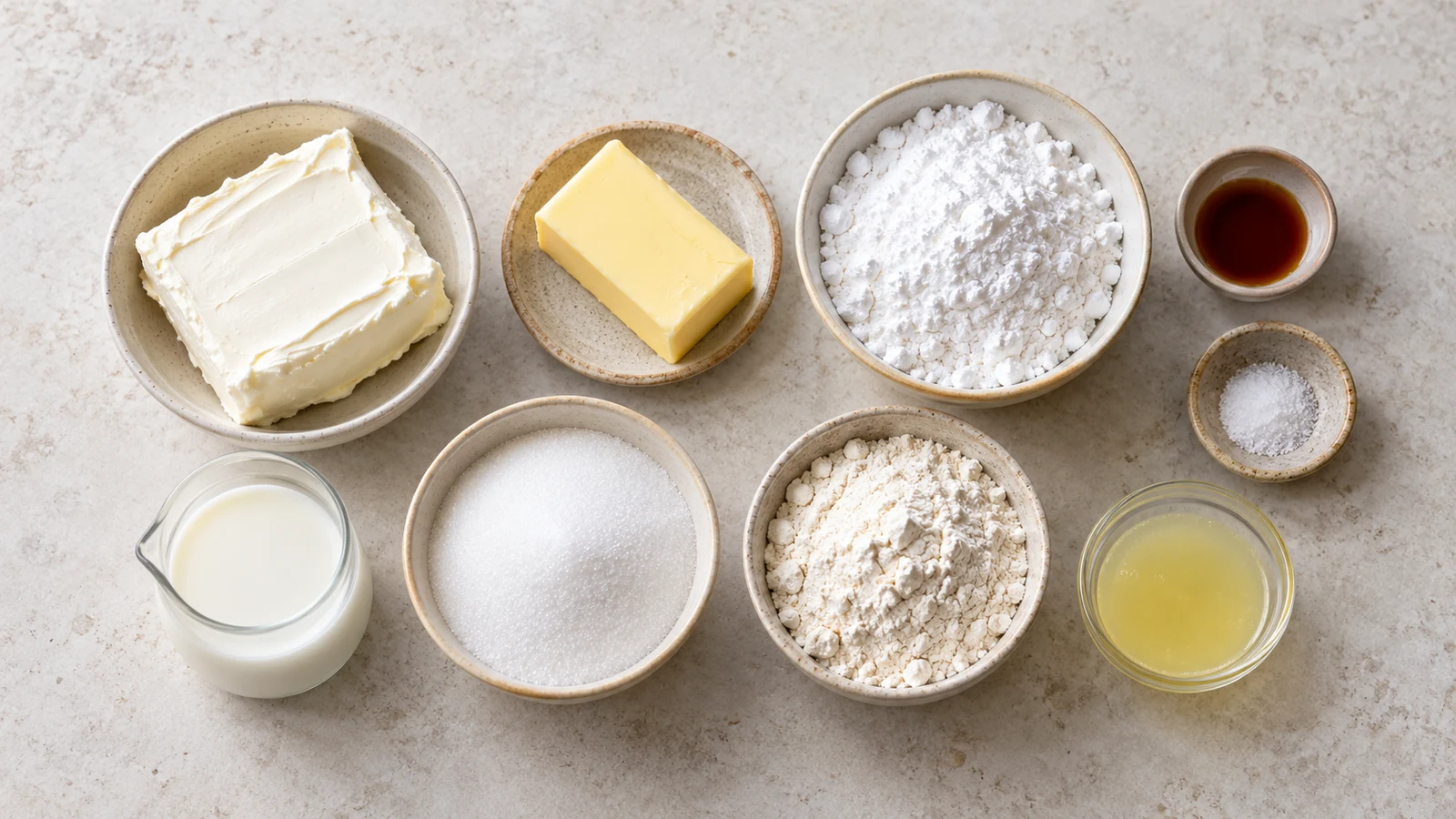
Use block cream cheese rather than spreadable tubs, which contain more moisture and can produce runny frosting. For a dairy-free version, use firm plant-based cream cheese and vegan butter sticks; results vary by brand, so keep both slightly cool. Powdered sugar is normally gluten-free, but check the label for certified gluten-free processing when preparing a gluten free red velvet cake recipe.
Why Ingredient Temperature Matters
Butter and cream cheese should be cool but workable, not equally soft. Butter needs enough flexibility to blend with powdered sugar, while cooler cream cheese helps the finished frosting retain structure. These narrow temperature ranges make the red velvet cake frosting recipe more reliable than simply leaving both ingredients on the counter for an unspecified time.
Test butter by pressing it gently with a fingertip. It should accept a shallow indentation without looking oily. Cream cheese should yield when cut but still feel cool. If either ingredient becomes shiny, greasy, or very soft, refrigerate it briefly before mixing.
How to Make This Red Velvet Cake Frosting Recipe
- Prepare the cake. Cool cake layers completely to room temperature, ideally below 75°F (24°C). Even slight warmth can melt the butter and loosen the frosting.
- Beat the butter. Using a stand mixer with the paddle attachment, beat softened butter on medium speed for 2 minutes, until creamy and one shade lighter. Scrape the bowl.
- Add the sugar. Mix in 4 cups powdered sugar, one cup at a time, on low speed. Once incorporated, beat on medium-low for 1 minute.
- Add the cream cheese. Cut cool cream cheese into eight pieces. Add one piece at a time on low speed, mixing only until each piece disappears.
- Finish gently. Add vanilla, salt, and optional lemon juice. Mix on low for 20–30 seconds, just until smooth. Avoid prolonged whipping, which can break down the cream cheese and make the frosting loose.
- Check the consistency. A lifted spatula should leave a soft peak that holds its curve. Chill for 15–20 minutes before decorating if the frosting feels softer than desired.
No stand mixer is required. Use an electric hand mixer at low to medium-low speed and scrape the bowl frequently. A sturdy spoon also works, although the butter must be properly softened and the finished texture may be slightly denser.
Expert Tips for the Best Results
- Keep the butter pliable but not shiny or greasy. It should indent easily without collapsing.
- Keep cream cheese cooler than the butter. Warm cream cheese releases moisture more readily.
- Sift lumpy powdered sugar before measuring for the smoothest finish.
- For less sweetness, begin with 3 1/2 cups (420 g) powdered sugar, understanding that the frosting will be softer.
- Do not add liquid food coloring to the frosting; it can loosen the texture. Gel coloring is more concentrated and is the better choice for decorative accents.
- Scrape the bottom and sides of the bowl after each major addition so no streaks of butter or sugar remain.
- Use the paddle attachment instead of a whisk when possible. It incorporates less air and gives the red velvet cake frosting recipe a smoother finish.
Mix Only as Long as Necessary
Cream cheese becomes softer as it is worked, so extra mixing does not make this frosting stronger. Add it after the butter and sugar have already formed a stable base. Once the final piece disappears, mix in the flavorings briefly and stop.
Decorate in a Cool Kitchen
A warm room can soften frosting even when the ingredients were prepared correctly. If the kitchen is warm, chill the filled cake before applying its final coat. Return the bowl to the refrigerator between decorating stages so the red velvet cake frosting recipe maintains clean ridges and borders.
Use a Crumb Coat
Red crumbs are especially visible against white frosting. Spread a thin, nearly transparent coat over the assembled cake, capturing loose crumbs as you work. Chill it for 20 minutes, then apply the final coat without dragging the spatula into the cake.
Consistency, Assembly, and Piping
For spreading, the frosting should glide under an offset spatula while retaining visible ridges. For piping rosettes or borders, it should form upright peaks. Chill it in 10-minute intervals if too soft; if too firm, let it stand at room temperature for 5 minutes and stir gently.
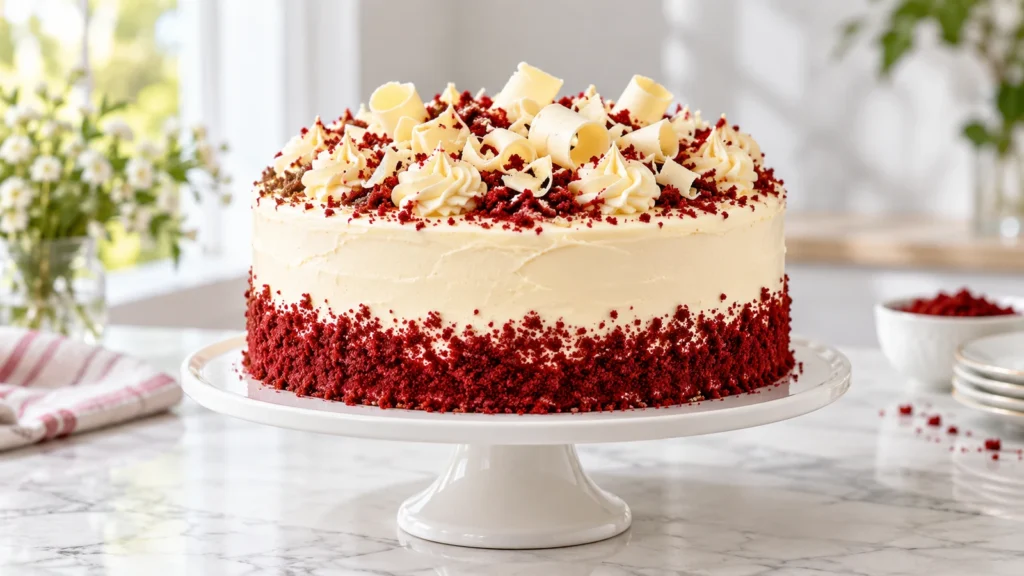
This batch makes about 5 cups, enough to fill and frost one 8- or 9-inch two-layer cake. Apply roughly 1 cup between the layers, then use the remainder for the top and sides. A thin crumb coat followed by 20 minutes of chilling makes the final coat cleaner. Use a large open-star tip for cupcake swirls and a round tip for borders or dots.
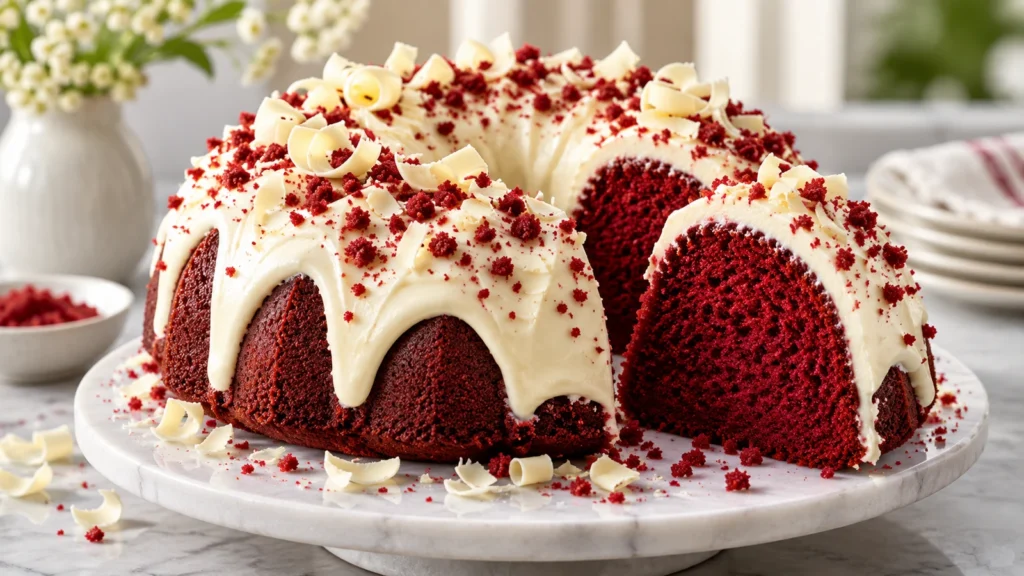
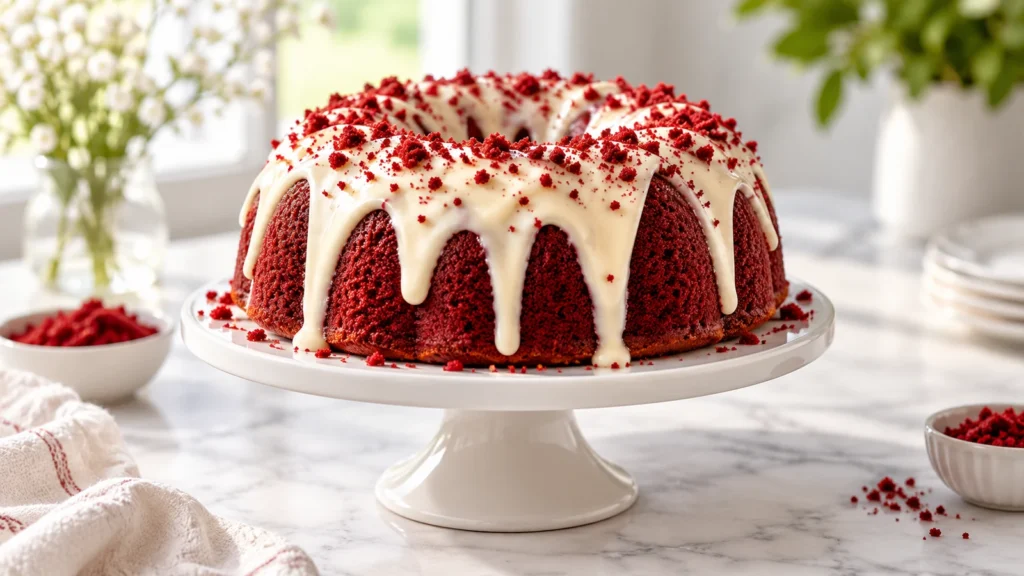
For a red velvet bundt cake recipe, make half a batch and soften it with 1–2 teaspoons milk for a thick drizzle. For 12 cupcakes, halve the recipe; for 24 generously piped cupcakes, prepare the full batch.
Filling and Stacking Layers
Place the first cooled layer on a flat serving plate or cake board. Spread the measured filling evenly, stopping just short of the edge so it does not squeeze out. Center the next layer and press very lightly. If the layers shift, chill the cake before continuing with the red velvet cake frosting recipe.
Creating Different Finishes
For rustic swoops, move the back of a spoon through the final coat in short arcs. For smoother sides, hold a bench scraper upright while turning the cake. Decorative red cake crumbs can be pressed around the base after frosting, but avoid pressing so firmly that the coating becomes uneven.
Troubleshooting Common Frosting Problems
Runny frosting: Chill it for 20 minutes, then stir on low. If still loose, add sifted powdered sugar 2 tablespoons at a time. Avoid adding large amounts, which can overwhelm the tangy flavor.
Split or curdled frosting: Ingredient temperatures were probably mismatched. Let a cold mixture stand for 10 minutes, then mix briefly on low. If it looks greasy, chill it for 10 minutes before mixing again.
Overbeaten frosting: Stop the mixer as soon as the cream cheese is incorporated. If it has become thin, refrigeration is more effective than continued beating. Small air bubbles can be removed by pressing the frosting against the bowl with a spatula.
Lumpy frosting: Cold butter or unsifted sugar may be responsible. Let the mixture stand for 5 minutes, then mix briefly on low and press stubborn lumps against the bowl. Do not continue beating for several minutes, because that can make the red velvet cake frosting recipe too soft.
Frosting that tastes too sweet: Add the optional lemon juice or a very small additional pinch of salt. Do not pour in extra liquid. Tang and salt balance sweetness more effectively without drastically changing the consistency.
Frosting that slides from the cake: Check that the layers are fully cool and free from condensation. Chill the cake and frosting separately, then reassemble. A crumb coat can also give the final layer a more secure surface.
Uneven color: Add gel color with a clean toothpick and mix gently. Allow tinted frosting to rest because many shades deepen over time. This is especially helpful when decorating a blue red velvet cake recipe.
Variations and Substitutions
Blue Red Velvet Cake Recipe
For a blue red velvet cake recipe, keep the frosting white for strong contrast or tint a small portion with navy gel coloring for borders. Gel color changes the consistency less than liquid coloring.
A white center and exterior also make the blue crumb more noticeable when the cake is sliced. If the blue red velvet cake recipe has a bold exterior, use tinted frosting sparingly so the finished design remains clear rather than visually crowded.
Cheesecake and Red Velvet Cake Recipe
This frosting reinforces the tangy filling in a cheesecake and red velvet cake recipe. Use a thinner layer so the rich cheesecake component remains the focus.
Keep every component chilled before assembly because a cheesecake and red velvet cake recipe is heavier than a standard layer cake. Apply frosting gently rather than pressing firmly against the cheesecake portion, and return the decorated dessert to the refrigerator promptly.
Gluten Free Red Velvet Cake Recipe
The frosting ingredients do not ordinarily contribute gluten, making this a natural partner for a gluten free red velvet cake recipe. Confirm the labels on powdered sugar, vanilla, gel coloring, and decorative toppings when cross-contact is a concern.
A gluten free red velvet cake recipe may have a more delicate crumb, so use a light touch during the crumb coat. Chill the layers before decorating if they feel fragile, and clean the spatula between passes to prevent loose crumbs from entering the white frosting.
Red Velvet Bundt Cake Recipe
When finishing a red velvet bundt cake recipe, a drizzle is often easier to apply than a full coating. Spoon the adjusted frosting over the highest ridges and let it travel naturally down the sides. Make sure the Bundt cake is completely cool so the drizzle remains opaque.
The ridges of a red velvet bundt cake recipe create built-in guides for an even finish. Rotate the serving plate as you drizzle, adding a little at a time. This gives better control than pouring the entire quantity over one spot.
Ermine Frosting Variation
For a less sweet finish, cook 1 cup milk, 1 cup sugar, and 5 tablespoons flour until pudding-thick. Cool completely, then gradually beat it into 1 cup softened butter with vanilla and salt. Use certified gluten-free flour if needed.
Flavor Adjustments
Add 1 teaspoon orange zest for a citrus note, or replace the vanilla with vanilla bean paste. For deeper cocoa flavor, sift in 2 tablespoons unsweetened cocoa powder and add powdered sugar as needed to restore the piping consistency.
Dairy-Free Substitution
Firm plant-based cream cheese and vegan butter sticks can be used, but brands vary substantially in water content and firmness. Begin with cool ingredients and expect to chill the mixture before decorating. Prepare a small test batch when the cake is for an important occasion.
Serving Ideas and Presentation
Serve frosted red velvet cake with fresh strawberries, raspberries, coffee, or unsweetened tea. The frosting also works well on chocolate cupcakes, carrot cake, spice cake, and cinnamon rolls.
For neat slices, chill the finished cake until the frosting is firm, then use a long sharp knife warmed under hot water and wiped dry. Clean and warm the blade between cuts. Let each slice stand for 20–30 minutes before serving so the cake and frosting regain their best texture.
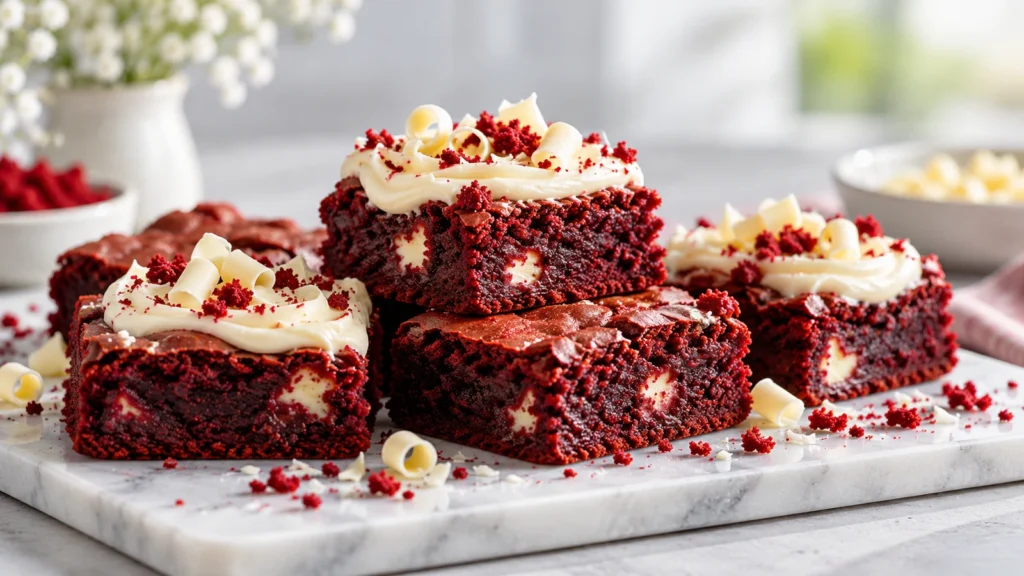
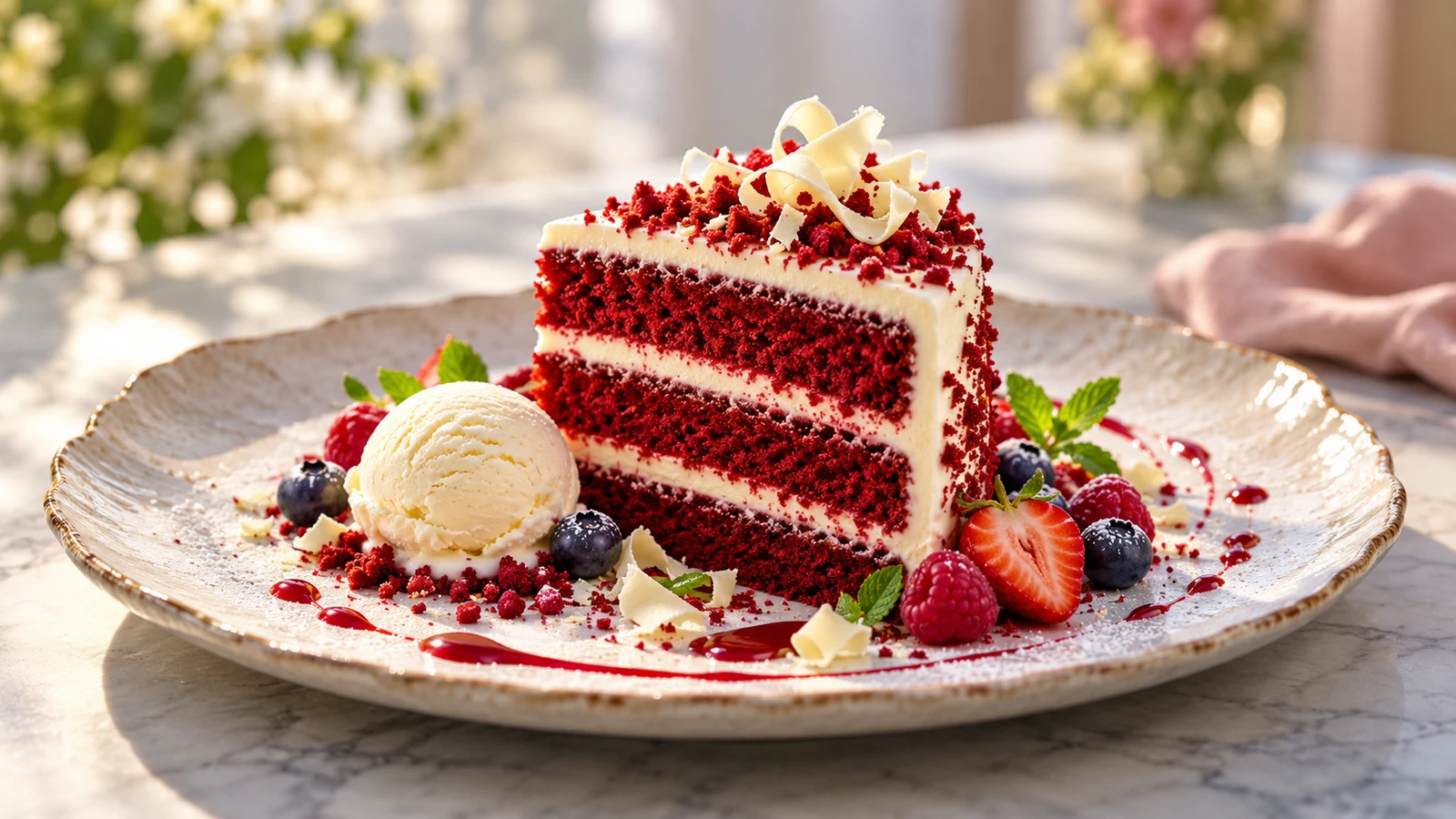
Use red cake crumbs, white-chocolate curls, fresh berries, or restrained gel-colored piping as decoration. A simple finish often suits a cheesecake and red velvet cake recipe, while generous rosettes make cupcakes feel celebratory. For a red velvet bundt cake recipe, follow the natural shape of the cake with the drizzle.
Make-Ahead and Storage Details
Refrigerate the frosted cake within 2 hours and store it covered for up to 4 days. General food-storage and safety guidance supports keeping perishable foods properly chilled. Let individual slices stand at room temperature for 20–30 minutes before serving; frosting should not be reheated.
Make the frosting up to 3 days ahead and refrigerate it in an airtight container. Bring it toward cool room temperature, then mix briefly on low to restore smoothness. Freeze it for up to 1 month, thaw overnight in the refrigerator, and remix gently. People at higher risk from foodborne illness should follow the FDA’s guidance for safely handling perishable desserts.
Preparing Cake Components in Advance
Cool and wrap unfrosted cake layers well before refrigerating or freezing them. Keep the red velvet cake frosting recipe in a separate airtight container until assembly. Separating the components protects the frosting from crumbs, odors, and accidental pressure during storage.
Storing a Decorated Cake
Chill the decorated cake uncovered just until the surface is firm, then cover it without pressing wrapping directly into the frosting. A cake carrier provides useful protection. Keep strong-smelling foods away because dairy-rich frosting can absorb refrigerator odors.
Freezing Leftover Frosting
Freeze the frosting in a tightly sealed container with minimal empty space. Thaw it overnight in the refrigerator rather than on the counter. Once thawed, let it soften slightly and stir gently; vigorous whipping can introduce bubbles or loosen its structure.
Frequently Asked Questions
Can I frost a warm red velvet cake?
No. The layers must be completely cool, preferably below 75°F (24°C), or the butter may melt and the frosting can slide.
Why is my red velvet cake frosting recipe too soft for piping?
The ingredients may be too warm, the cream cheese may contain excess moisture, or the mixture may be overbeaten. Chill it for 15–20 minutes before adding more sugar.
How much frosting do I need for a three-layer cake?
Make 1 1/2 batches for three 8-inch layers with moderate filling and full exterior coverage. Double the recipe for elaborate piping or very thick layers.
Is this red velvet cake frosting recipe gluten-free?
The basic ingredients contain no gluten, but powdered sugar, vanilla, and substitutions should be checked for cross-contact. Ermine frosting requires certified gluten-free flour if adapted.
Can I use this on a gluten free red velvet cake recipe?
Yes. The creamy texture pairs well with a gluten free red velvet cake recipe, and a thin crumb coat helps contain a delicate crumb. Verify every packaged ingredient if certified gluten-free preparation is required.
Can I use spreadable cream cheese from a tub?
Brick-style cream cheese is the dependable choice. Tub cream cheese contains more moisture and often produces frosting that is too soft for layer filling or piping. If it is the only option available, expect a softer finish and keep the frosting chilled.
Can I reduce the powdered sugar?
Yes. Begin with 3 1/2 cups (420 g), but remember that sugar provides structure as well as sweetness. The lower-sugar version is better for spreading than detailed piping and may require additional chilling.
Which finish works best for a red velvet bundt cake recipe?
A thick drizzle made from half a batch is well suited to a red velvet bundt cake recipe. Add 1–2 teaspoons milk as directed, checking the flow after each small addition so the frosting does not become too thin.
How should I decorate a blue red velvet cake recipe?
White frosting provides the clearest contrast on a blue red velvet cake recipe. For extra detail, tint a small amount with navy gel coloring and use it for borders, dots, or restrained rosettes.
Does this work with a cheesecake and red velvet cake recipe?
Yes. Use a thinner coating on a cheesecake and red velvet cake recipe so the cheesecake filling remains prominent. Keep the cake chilled during assembly and storage because both the frosting and cheesecake contain perishable dairy.
Can I make the frosting without a mixer?
Yes. Use a sturdy spoon or flexible spatula and make sure the butter is properly softened. The texture may be denser, but it will still spread well. Add the cream cheese gradually and stop stirring as soon as the mixture is smooth.
Why are there air bubbles in my frosting?
Mixing at high speed traps extra air. Run the mixer briefly on low, then press the frosting against the bowl with a flexible spatula. When coating the cake, use long, steady strokes rather than repeatedly lifting the spatula.
Can I leave a frosted cake at room temperature overnight?
No. This frosting contains perishable cream cheese and should remain refrigerated. Bring only the amount you plan to serve toward room temperature, and return leftovers to the refrigerator promptly.
Recipe Card
Yield: About 5 cups; enough for one 8- or 9-inch two-layer cake or 24 cupcakes
Prep time: 15 minutes
Chilling time: 20 minutes, if needed
Total time: 15–35 minutes
Equipment: Stand mixer with paddle or hand mixer, large bowl, flexible spatula, measuring cups or kitchen scale, offset spatula, and optional piping bag and tips.
Method: Beat 1 cup (226 g) butter at 65–68°F (18–20°C) for 2 minutes. Gradually mix in 4 cups (480 g) powdered sugar. Add 16 ounces (454 g) cream cheese at 60–65°F (16–18°C) piece by piece on low speed. Mix in 2 teaspoons vanilla, 1/4 teaspoon salt, and optional lemon juice just until smooth. Chill briefly if needed.
Approximate nutrition: Per 1/12 batch, about 445 calories, 29 g fat, 45 g carbohydrate, 43 g sugar, and 3 g protein. Values vary by brands and serving size.
A Dependable Finish for Every Red Velvet Cake
With controlled ingredient temperatures and minimal mixing, this red velvet cake frosting recipe stays creamy, balanced, and easy to decorate. Cool the cake fully, watch the visual consistency cues, and chill briefly whenever the texture needs extra support.
Whether you are finishing a classic layer cake, a red velvet bundt cake recipe, a blue red velvet cake recipe, a cheesecake and red velvet cake recipe, or a gluten free red velvet cake recipe, the same principles apply: begin with cool ingredients, mix gently, and store the finished dessert safely.
Reviews
Reader reviews are managed separately (outside this build).